Can ChatGPT and Claude Code work together?
Yes — but they work best through a shared brief, Git and explicit handoffs. They should not write into the same checkout while guessing what the other agent is doing.
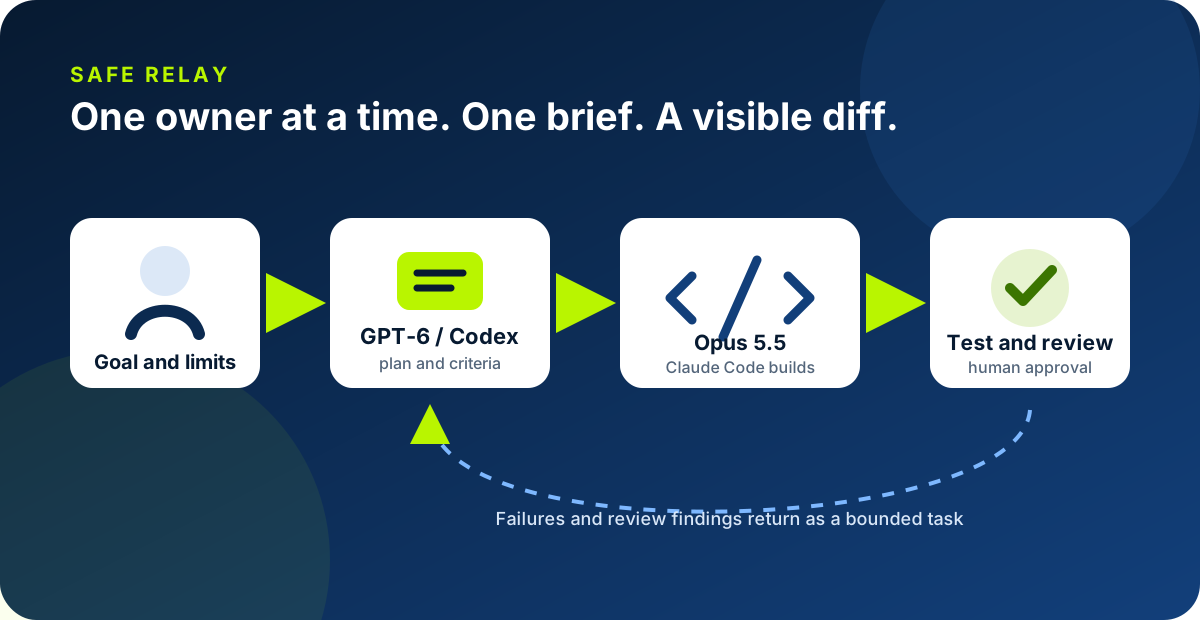
The safest starting point is a relay: plan → build → test → independent review → human approval.
ChatGPT, GPT‑6 and Codex are different things
ChatGPT is the product you converse with. GPT‑6 is a model family that may power the work. Codex is OpenAI's coding agent and harness around the model, with access to a repository, files, a terminal, tests and diffs. On Anthropic's side, Claude Opus 5.5 is the model while Claude Code is the coding agent that works in your terminal and project.
The useful question is therefore not merely whether two models can “talk,” but how two agent environments share the truth about a task without colliding.
Recommended split: GPT‑6 plans and reviews, Opus implements
OpenAI recommends GPT‑6 Sol as a natural Codex choice for agentic software work. Anthropic positions Opus 5.5 for long-running agentic coding and demanding knowledge work. One useful division is:
- 1 · BriefA human sets the goal and limits. Define the observable outcome, components in scope, tests that must pass and actions that require approval.
- 2 · PlanGPT‑6 Sol or Astra writes the plan and acceptance criteria. Ask for risks, ambiguities and an explicit out-of-scope list.
- 3 · BuildClaude Code with Opus 5.5 implements. Give it the plan, the relevant branch and ownership of a bounded file set.
- 4 · VerifyTests decide what machines can decide. Run build, lint, type checking and targeted tests before review.
- 5 · ReviewCodex/GPT‑6 reads the diff, not the entire conversation. It looks for defects, missing tests, security risk and deviations from the brief.
- 6 · ApproveA human decides whether to merge and deploy. Models can propose; consequences need a named owner.
A handoff format both agents understand
Keep the working agreement in a short repository file such as agent-handoff.md. Treat that file as the source of truth rather than copying a long chat transcript.
# Task
Goal: [observable final result]
Scope: [files, folders or components]
Do not: [out of scope]

# Acceptance criteria
- [testable expectation]
- [testable expectation]

# Verification
Run: [build, lint and tests]
Report: changed files, test results, assumptions and open risks

# Handoff
The next agent must read this file and git diff before proposing changes.
Put shared project rules in one vendor-neutral file and point to it from both AGENTS.md and CLAUDE.md. Avoid maintaining two long, nearly identical rulebooks that eventually contradict each other.
When they can work in parallel
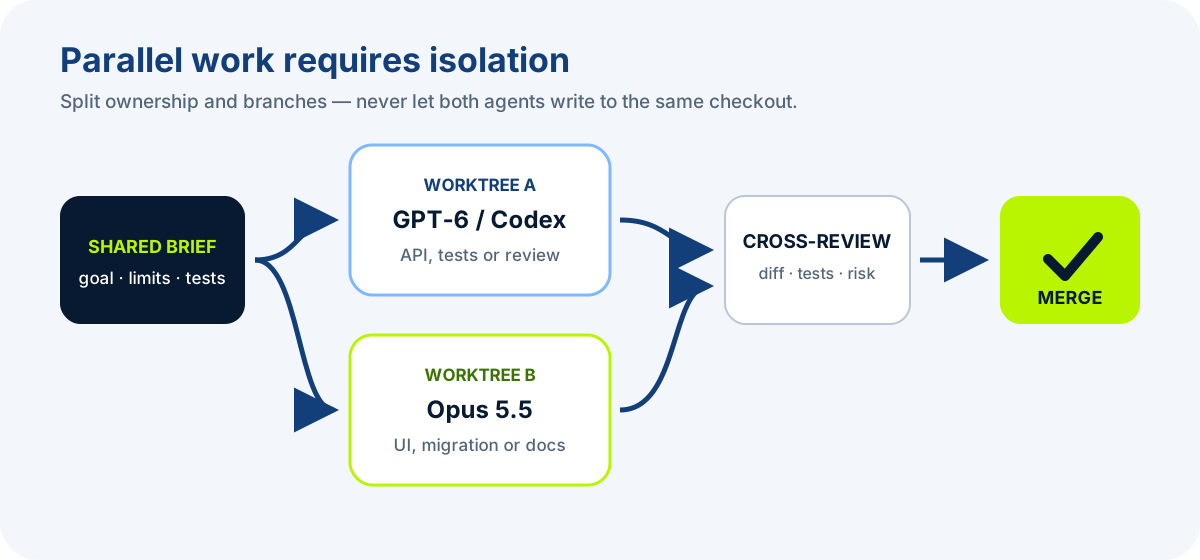
Separate worktrees make parallel changes visible, reversible and reviewable before merge.
Parallel work is useful when tasks are independent: one agent can write tests while another implements, or one can own the API while the other owns the UI. OpenAI emphasises isolated agent contexts and explicit coordination; Anthropic documents Git worktrees for parallel Claude Code sessions.
| Pattern | Use it when | Avoid it when |
|---|---|---|
| RelayGPT‑6 → Opus → GPT‑6 | each change depends on the last, or you want independent review | wall-clock time matters more than review depth |
| Parallel worktrees | tasks own separate files, components or test responsibilities | both must edit the same migration, configuration or core file |
| Reviewer–implementer | risk is high and a different model should challenge assumptions | the task is small and tests already give an unambiguous result |
| API orchestration | the workflow repeats often and needs routing, logging and budgets | you only need to finish one change in a local project |
Three rules that prevent the common conflicts
- One agent owns a file at a time. If file scopes overlap, use a relay rather than parallel editing.
- Give each agent its own branch or worktree. Do not start two writing agents in one checkout.
- Tests and the diff are the contract. The next agent verifies the result instead of trusting the previous agent's summary.
Can you connect them directly with APIs or MCP?
Yes, in a custom integration. A coordinator can call both OpenAI and Anthropic APIs, or give agents access to the same external systems through MCP. But MCP is a tool connection, not automatic model-to-model conversation. You must still define routing, shared data, permissions, budgets, logging and stop conditions.
medium. Integrations moving from Opus 5 must remove attempts to disable thinking and check forced tool use against Anthropic's migration guide.For most teams, GitHub/Git, task files and CI are a better first coordination layer than a custom orchestrator. Automate only after the manual relay is stable and repeats often.
What does this collaboration cost?
Two premium agents do not automatically produce twice the quality, but they can produce roughly twice the model work. Opus 5.5 costs $4 / $20 per million input/output tokens; standard short-context GPT‑6 pricing is $2 / $10 for Sol and $10 / $50 for Astra. Long context, caching, batch and faster processing use different rates. Use Sol for ordinary planning and review, Luna or inexpensive static analysis for simple checks, and Astra only when complexity or consequence justifies it.
Measure cost per accepted change. An expensive first pass can be cheaper if it eliminates three repair rounds, but premium review of a trivial CSS change is usually waste.
Frequently asked questions
Can ChatGPT and Claude Code work together?
Yes. The simplest approach is to have ChatGPT or Codex produce a plan or review while Claude Code implements in the same Git project. Share context through a brief, commits, diffs and tests. Direct communication between the products requires a custom API- or MCP-based integration.
Can Claude Code call ChatGPT?
Claude Code can run an approved script or use a tool that calls the OpenAI API. That requires an API key, cost controls and explicit permissions. It is a custom agent setup, not a universal built-in connection to your ChatGPT account.
Can ChatGPT control Claude Code on my computer?
A normal ChatGPT conversation cannot automatically control a local Claude Code process. Codex can work on the same repository before or after Claude Code, and a custom local orchestrator can connect CLIs or APIs.
Should both agents write to the same folder at once?
No. Use separate worktrees or branches, or let them work in sequence. Concurrent writes in one checkout create file collisions, unclear ownership and tests whose underlying files change while the other agent is running.
Which model should be the boss?
There is no universal answer. Choose one coordinator for the workflow. GPT‑6 Sol is a natural Codex choice for day-to-day coding, while Opus 5.5 is designed for long-running agentic coding. Reverse the roles in another evaluation if your own tasks perform better that way.
Sources
- OpenAI Docs: Code generation — Codex, GPT‑6 Sol and API-based coding
- OpenAI Docs: Agents API multi-agent — isolated subagents, coordination and shared environments
- OpenAI: Model guidance for GPT‑6 — model choice and agentic work
- OpenAI: API pricing — standard, long-context, cache and processing rates
- Claude Code: Common workflows — parallel sessions, worktrees and subagents
- Claude Code: Extend Claude Code — MCP, skills, hooks and isolated context
- Anthropic: Models overview — Opus 5.5 and its current role
- Anthropic: Migrating to Opus 5.5 — effort, thinking and API changes